Blog

  • Activity of the week: Fun food growing at home

    At MTO, we enjoy teaching the children where food comes from. We believe that children learn from hands-on play, so we encourage parents to get involved as much as possible. Hence, the activity of the week is fun food growing at home.

    You don’t need to invest a lot of time and money in the activity. It can be completed with the things that you have around your home.

    Salad Cress Heads

    Do you have any empty eggshells? Don’t throw them away! You can use them as a container to plant herbs. You may see results within a week. Here’s what to do:

    Help your child to decorate the shells. You can think about drawing faces on the shells and watch it ‘come alive’ as the cress will look like hairs. This is an excellent opportunity to open a conversation about emotional well-being. Follow the guide below:

    • Place a wet kitchen-roll sheet at the bottom of the shell. You can also use cotton wool if you wish
    • With the help of a teaspoon, sprinkle some seeds onto the wet sheet and gently press them into the material
    • Find a spot by the window with sufficient sun throughout the day and easy access for the child
    • Encourage your child to sprinkle some water into the shell every day until the cress grows tall
    • When the cress is around 5cm, you can cut it down and use it for a nutritious boost

    If you notice that your child enjoys nurturing, you can think about making their very own indoor garden. At home, you can easily grow vegetables such as oregano, basil, and parsley. Additionally, you can also invest in some plants to have around the house.

    Instead of throwing the eggs carton away, you can create your child’s very own greenhouse!

    Follow the steps below:

    • Cut off the lid of the egg carton and recycle it
    • Similarly, with the salad cress heads, you should let your child decorate the carton however they like
    • For the best results, you should add up to 3/4 of soil to each hole
    • For every hole, you can add any herb or flowers you and the child wish. Don’t forget to add a little water to every spot that is used
    • To have the greenhouse effect, you should cover the carton with a layer of cling film and place it in a sunny spot that is easy to reach for the child
    • Once you notice that the seeds are beginning to sprout, remove the cling film and water every day.

    Benefits from this week’s activity

    People of all ages benefit from nurturing and taking care of things. However, in particular, children will have fun and learn how to take care of fragile things.

    Sensory development

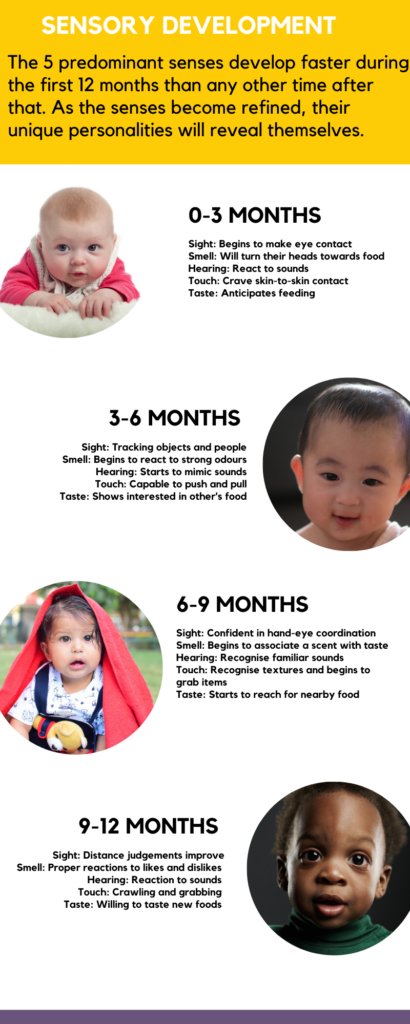
    If you encourage your child to engage with this activity, you help with the sensory development. Children can feel the texture of the seeds, soil, and herbs. They can also smell it and discover new smells. Additionally, it also helps with hand-eye coordination and better physical strength as the child will be digging, sieving, and watering.

    Encourages healthy eating

    Without a doubt, many parents struggle to make children eat healthy food. If children can see where their food comes from, they will most likely gain an interest in tasting the food. They will also get a sense of achievement as they’re eating the food that they’ve grown themselves.

    Teaches responsibility

    When you allow your child to grow things, you teach them how to be responsible. If you assign particular duties to each child, they will see the consequences of their actions. For instance, if they don’t water the vegetables, they will not grow. You’re also teaching them about the world and how things have cause and effect.

    Conclusion

    To make your child enthusiastic about food, you have to be too. Make it exciting and allow them to use their imagination when it comes to food. You will notice that once you’re excited about vegetables, your child will be too.

  • How We Help Children Transition To School

    [cmsmasters_row][cmsmasters_column data_width=”1/1″][cmsmasters_text]

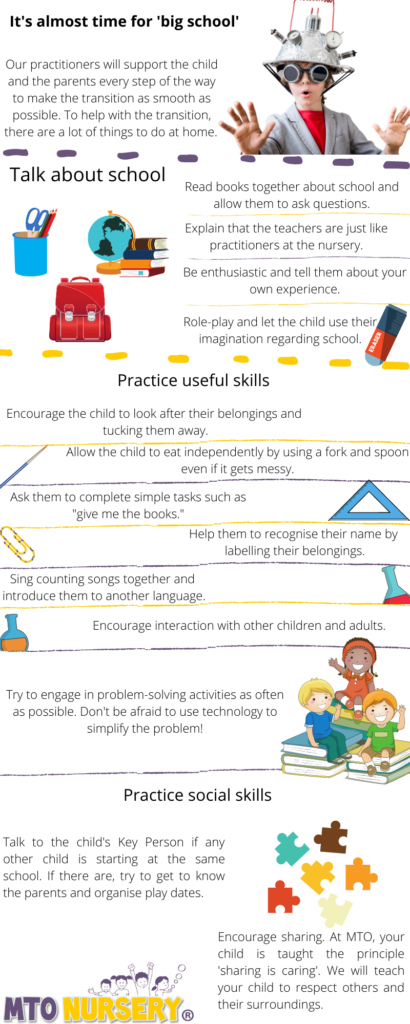
    The move from nursery to school is an important milestone for the child and you. Hence, our practitioners take many steps to prepare the preschoolers for ‘big school.’ So, through the support given, your little one will be ready for the big day.

    Our staff will also provide all of the advice and reassurance needed for parents and carers. The goal is to make the transition as smoothly as possible for both parents and children.

    We teach more than just numbers and letters

    Your little one will need more than just acknowledging letters and numbers. Although such a skill is essential, they will need much more to do well at school. Thus, we will teach them independence and confidence.

    Every Key Person will ensure that they work together with their children to build a range of skills so that the child will:

    • Develop efficient communication so that they feel confident to make their feelings known to adults
    • Build confidence so that the child will answer questions, even if the answer is wrong. As well as ask questions regarding any subject
    • Have reasonable control over their behaviour and coping mechanism when emotions are running high
    • Feel comfortable asking for the toilet, washing their hands, and dressing and undressing on their own
    • Respect other children and adults, make friends and share their own
    • Comfortably solve simple problems without help and be willing to try new tasks

    At MTO, we use the latest teaching strategies to ensure that the children have the necessary skills and other helpful ones. For instance, our practitioners will count and sing in different languages such as Spanish and French.

    Activities to prepare for the big day

    Every day, we run a range of activities to help the little ones prepare for the school environment.

    The children will follow a timetable, similar to a school one. They enjoy PE sessions and self-serve meals. We also practice lining up, putting shoes on, and taking them off. A variety of activities involve children sitting at a table and sharing resources with others.

    At story-time, our practitioners talk about ‘big school’ and encourage children to ask questions. We encourage parents to do the same at home to help children get used to the idea.

    Activities at home to prepare your child

    For the child to feel comfortable in a school environment, they must be comfortable to do simple tasks with minimal help from the adults. You can support them by:

    • Resisting the temptation to pop the child on the loo and wiping them. Through the support at the nursery, your child will gradually get in the habit of doing it themselves
    • Avoiding buttons, buckles, or complicated accessories that will make it difficult for the child to get dressed without any help
    • Allowing the child to put on their shoes, regardless of how long it takes. To speed up the process, you should think about purchasing Velcro-fasteners shoes
    • Let the child open lunchboxes, cartons, and food packages by themselves. Furthermore, they should also use a knife and fork when necessary
    • Encourage your child to solve simple problems by themselves. They should be able to let you know when they don’t understand how to solve the task ahead
    Work on social skills

    At the nursery, children interact and play with each other. The daily activities teach children to respect each other and their surroundings. This critical skill will make it easier for them to settle at ‘big school.’ To assist us at home, you should try the following:

    • Organise play dates (preferably with other children at the nursery) – being around other children as much as possible will make the school environment less scary. If such action isn’t possible yet, virtual meet-ups are also a great option
    • Roleplay – by the time the child starts primary, they should know how to say “hello” or greet others. Use soft toys and figurines to make it as real as possible
    • Communicate – Speak with your child rather than at your child. Allow the little one to talk, ask questions, and also listen. The conversations should have an essence to them, so practice questions such as “how was your day today?”
    • Encourage sharing – A good idea would be to play board games with the child. Ask questions such as “whose turn is it next?”
    Practice early literacy and numeracy

    Your child doesn’t have to have strong literacy and numeracy skills because it is what school is for! At home, you should start to get the child ready for learning by:

    • Ensure that they recognise or react to their name – To make it easier for them to learn their name, you can keep clothes and footwear labelled
    • Introduce them to numbers – Sing counting songs together or count objects around them. For instance, ask the child if they can bring a specific number of plates and cups for you at the dinner table
    • Work on the fine motor skills – Let the child use scissors, beads and strings, and paint. This action will allow them to build stronger hand-eye coordination. At the nursery, we have many activities involving drawing, coloring, and mark-making
    • Read stories – Reading will improve not only their vocabulary but also their listening skills

    You should talk to your child about how exciting the next chapter will be. Allow your child to ask questions about what’s coming next and listen to their concerns or worries.

    Conclusion

    It’s normal for the child to be a bit anxious when it comes to changes. The best thing that you can do for your child is to focus on the positives and how fun it will be. Our practitioners are here to help you every step of the way to ensure a positive transition.

    [/cmsmasters_text][/cmsmasters_column][/cmsmasters_row]

  • The Importance of Sensory Play in Child Development

    From birth until early childhood, children explore and learn about the world by using all of their senses. Sensory play is a crucial part in the early childhood development as it allows children to retain information by engaging their senses. Numerous memories that adults have are associated with one or more senses.

    Research shows that babies will learn about their environment by interacting with it rather than passive observation. Additionally, the experiences they gain are proven to be calming and therapeutic as it allows them to work through emotions and frustrations.

    Providing babies and toddlers with opportunities to actively use all of their senses throughout the day will lead to better ability of the child to complete complex tasks. As we are big on sensory play at MTO, we encourage better language development, social interaction, and problem-solving skills.

    What is sensory play?

    All of the activities that are designed for sensory play will stimulate the children’s five senses. Inevitably, children are natural scientists, they enjoy touching, tasting, and experimenting in the environment that they find themselves. When they’re outside, you will notice them picking up sticks, leaves, and rocks. Our nursery will provide the means and materials needed but we encourage self-regulated actions from the children.

    In every room, there are numerous sensory materials that improves the children’s sense of touch. Such activities will lay the foundation for developing other skills such as identifying objects and using their gross motor skills. At home, you can help the child to refine the skills by providing them activities such as splashing, moulding, and scooping.

    Furthermore, our practitioners also motivate children to share the toys and materials available. As they become more confident in using their verbal skill, they will begin to discuss the differences between the objects they touch, hear, see, and taste. Also, they will begin to share their discoveries with peers and therefore build relationships.

    To ensure that all of the children benefit from effective sensory experiences, we have treasure baskets and messy play trays in the baby room and for the older children there are tables and chairs around the room so that the children can sit at the table and explore playdough, crafts, and painting.

    How to help your child at home

    It’s important to mention that sensory play isn’t just about picking up stuff and feeling the texture. Realistically, such play is limited only by our imagination. At home, you can try the following:

    • Babies – Use soap and water to create bubbles. Ensure that the baby is watching the bubbles float and allow them to land on its skin. Moreover, you can also scrunch some coloured paper near them and let them hear the noise, feel the contours of the paper and see the changes in shapes.
    • Toddlers – Use a torch light to create different shadows and light on different objects that don’t have similar sizes and shapes. Also, you can let the child to mix paint colours and create forms and textures with fingers and sponges.
    • Pre-schoolers – Let the child to play with kinetic sand and musical instruments. In addition, you can join in the pretend-play and interactive story telling.

    Don’t forget that the most stimulating environment for children is the outdoors as they are surrounded by colours, textures, smells, and sounds.

    The importance of sensory play

    It’s essential to allow children to take part in sensory activities as it helps to create nerve connections in the brain’s pathways so that they can figure out for themselves what is important to learn and what to filter out. For instance, some children in early childhood will find it difficult to play with other children if there’s too much noise around them. Proper sensory play will teach the child to learn to block out the distraction and focus on what’s important at that time.

    Another example is the fussy-eater that refuses to touch new textures. Sensory play in an environment with little expectations will help the child to discover and explore by touching and smelling. As the child is understanding the texture, a new positive connection will be built in the brain’s pathway. Hence, the child will be willing to at least try to taste new textures in foods.

    What we do at MTO to include sensory play

    In our Discoverers room we have treasure baskets, toys of different shapes and sizes, and materials from different textures. Furthermore, we also have a tray for messy and water play. All of our children enjoy making sensory experiences for themselves by painting and using paste to create their own shapes and textures. Babies are allowed to move freely around the rooms and discover their surroundings.

    Additionally, in our Explorer room, there’s a chalk board, tray for messy play, tables for painting, and throughout the area there are spaces specifically designed for pretend play. Our practitioners initiate activities and engage in open conversations with the children. The discussions have essence to them so that the toddlers can learn and play at the same time.

    Finally, in our Inventors room, our pre-schoolers have an open space to explore as much as they desire. Each area has a specific purpose so that it fits their age-appropriate needs that will help them to get ready for the next phase in their educational journey. The environment enables them to use media and technology, express themselves through music, art, and drama.

    Conclusion

    All of our activities for sensory play will help the children to learn and play at the same time – notably children of all abilities and backgrounds – show interest and engage with our practitioners throughout the day. The materials available appeal to children of all ages. Every day, we encourage children to experiment with the five predominant senses as we believe that it will help them to become responsible long-life learners.

  • Bedtime Trouble: Tips for Parents

    Are you struggling with infant sleep problems? If so, you should know that you’re not alone. It’s important to understand that sleep needs vary depending on age. Even though you will notice that your newborn will sleep most of the time, the sleep is in short segments. As they grow, the sleep segments shorten, but the duration of the rest increases at nighttime.

    In addition to this, babies go through different sleep cycles. It’s known that babies will spend less time in REM sleep (deep sleep). Additionally, most babies will not sleep through the whole night until they reach three months of age.

    What are the signs that your infant has sleep problems?

    Sleep apnoea is more common than scientists previously thought. Many parents believe that the child finds it difficult to fall asleep due to health issues. However, some will find it challenging due to overtiredness, overstimulation, and separation anxiety.

    If your child is experiencing night awakenings or restless sleep, you will see the following:

    • Suddenly crying more than once at night
    • Refusing to fall asleep if the parent isn’t nearby
    • Crying when the adult leaves the room
    • Clinging to the parent until they fall asleep

    Don’t forget that sleep problems can also stem from illness. If your baby has trouble falling asleep during the day and night, it’s best to seek the help of a professional.

    Signs that your child is ready to fall asleep

    You will notice that the infant is rubbing their eyes and yawning. They are also fussing and refusing to settle.

    To remember: Toddlers will continuously test boundaries to figure out on their own what is right and wrong. Refusing to sleep is a way to do that.

    How to help your baby at bedtime?

    It’s important to understand that babies don’t know how to establish their sleeping and waking patterns. Besides, they won’t be able to put themselves back to sleep when they wake at night. Hence, establishing a routine will help the process.

    Some parents choose to rock or cuddle their babies until the infant falls asleep. Nonetheless, this isn’t a recommended practice as the baby will not fall asleep unless you follow the same procedure at all times. Such a pattern is also challenging to get rid of.

    On the other hand, cuddling and nurturing the baby during the day will allow them to feel better about separation when it’s bedtime. Furthermore, you can also try the following:

    • Avoid activities before bedtime. Their energy levels will be higher, so they will refuse to settle
    • Play soft music when the baby is sleepy and falling asleep. You can choose how low or high the volume should be
    • When you notice the baby giving you signs that it’s ready to sleep, tuck them into bed
    • Avoid taking the infant from the bed if it’s not settling in bed. Instead, soothe and reassure until it falls asleep
    • Ensure that the baby is taking age-appropriate naps. Too many naps during the day will prevent them from falling asleep at night

    It’s also a good idea to introduce a transitional comforter or a soft toy that the baby can take to bed. However, beware of the risk of suffocation if the child is not old enough.

    How to help your toddler at bedtime?

    There are many ways the toddler will use to avoid going to bed. Thus, you shouldn’t be disappointed if you’ve set a bedtime routine. Below you will find the solutions to the reasons why they do not want to fall asleep.

    Reason: Tantrum

    Solution: You should stick to a schedule as much as possible because it will ease the child’s transition from being active to falling asleep. Additionally, you should also remind the toddler about the schedule. For instance, you can say, “After bath time, it’s time to brush your teeth, and then you will go night-night.” Such action will allow the child to know what’s coming next.

    Reason: Cries out when the parent leaves the room

    Solution: You should try to set timed visits to the toddler’s room rather than respond every time you hear a cry. You have the freedom to decide how frequent the visits are and how long you remain in the room. Before you leave, ensure that the child has a clean diaper and isn’t in pain.

    Reason: Continuously gets out of bed

    Solution: One of the main reasons the child doesn’t want to settle is due to separation anxiety. If your toddler doesn’t want to remain in its bed, you should have up to 30 minutes of quiet time. The child should stay in its bed while you read, snuggle, or listen to soft music.

    Reason: The toddler is taking too long to fall asleep

    Solution: Ideally, you shouldn’t do anything that will affect the bedtime routine. The child shouldn’t have late afternoon naps or stay up more than necessary. So, you should schedule the nap time according to their age and specific needs.

    Ways MTO nursery helps to improve the child’s sleeping schedule

    At our nursery, we respect the wishes of our parents. So, if you prefer that your toddler doesn’t sleep, we will work with parents. However, we will not refuse the child if it wants to rest. Every day, we bring out spare beds for the children that don’t usually sleep.

    Furthermore, in our baby room, we have the coracle beds that fit our vision of creating independence. Our practitioners will soothe the babies to sleep and allow them to rest by playing soft music and turning off the lights. Also, we enable the children to have comforters.

    Conclusion

    You are not going through this alone. Numerous babies and young children have trouble when it comes to falling asleep at night. Your bedtime routine must be calming and predictable. So, everything should happen at the same time, every night.

    Even though it’s tempting to provide them with a tablet or a phone to look at when they’re not settling, you should avoid doing this at least 60 minutes before bed. The light they see from the device will trick their minds into thinking that it’s not bedtime.

  • Teething in Babies: Know the signs and symptoms

    [cmsmasters_row][cmsmasters_column data_width=”1/1″][cmsmasters_text]

    Teething can be a frustrating time for carers, and although it’s inevitable in the baby’s development, most parents wish the time away. After all, who wants to see their baby in pain? Getting through this stage can be painful for the child and worrying for the parents.

    It’s important to mention that some babies show no signs of teething, and some will suffer for many months. Nonetheless, if you know what signs and symptoms to look out for, you can alleviate the discomfort without a professional’s help.

    When do babies get teeth?

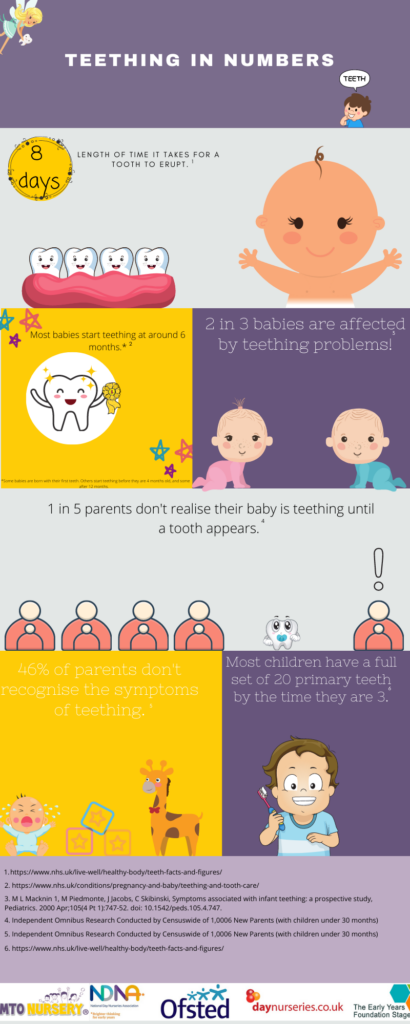
    In some instances, the baby can be born with a tooth or two. Nonetheless, although the time frame isn’t a rule, you will be able to notice your baby’s first teeth between 6 to 12 months old. However, by the time the child reaches 3-years old, they should have a full set of teeth.

    You will notice that around three months of age, your baby will begin to discover the environment around them by increasingly putting toys and their hands in their mouth. Usually, the first teeth will appear in pairs or one after the other within a short time. Most commonly, the first teeth are the two bottom front teeth.

    Take a look at the chart below:
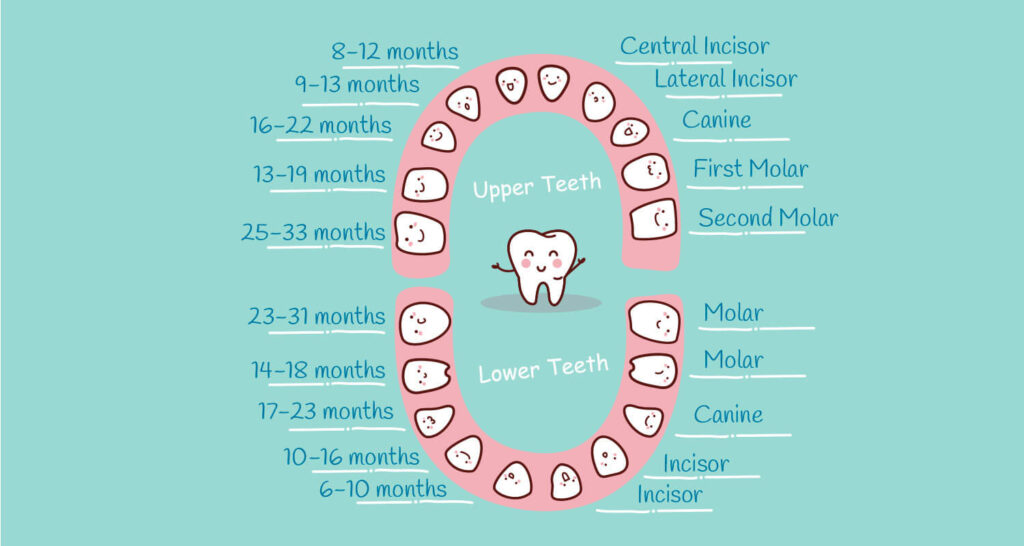
    Without a doubt, baby teething is a stage in their development that sneaks up on you unexpectedly. The symptoms can appear before you even think to look for changes in the child’s mouth. Thus, it’s essential to familiarise yourself with the typical symptoms and signs.

    So, what are the symptoms?

    Biting and Gnawing

    Your baby will begin to bite on anything that they can see, including spoons, toys, and fingers. Even though they’ve only been around for a few months, they figure out that chewing is a pain reliever. As their gums are irritated, the counter pressure from biting will relieve some of their gums’ discomfort. So, as the tooth is pushing up, the item they bite will push down on the tooth, hence, relieving the painful pressure.

    How to help: It can be challenging to allow your child to bite on everything that comes into sight. However, if it’s safe and hygienic, you shouldn’t worry. The best option is to purchase baby teether toys.

    Drooling

    Sometimes it can be too sticky, slimy, and unpleasant when it gets on clothes, furniture, and you. Fortunately, though, increased drooling is a good sign when it comes to a baby teething. Think of all of the baby’s things in their mouth; sometimes, it can be doorknobs, dirty toys, and unsensitised items. The drool is similar to a protective barrier as it’s like a cushion for the gums.

    Defendant Drool, to the rescue!

    Additionally, the antibodies in the drool will protect gums from potential infections. Regardless of how vigilant you are, your baby will find something weird to put in their mouth.

    To remember: There are several reasons why babies experience excess drooling. If the baby isn’t showing the other signs of teething, you should seek a professional’s help.

    How to help: Drooling bibs are an excellent option if you don’t want drool on clothes. You must ensure that the material is hypoallergenic and safe for the baby’s sensitive skin. A good quality bib will absorb the floods of drool, so you don’t have to change outfits every few hours.

    Rash Around Mouth

    As the drooling is working overtime, it’s common for babies to have a rash. You will notice tiny red bumps that can look anything like a beard or a mustache.

    How to help: You can slather some Vaseline as soon as the skin turns red so that the saliva will slide off the face.

    Cranky and Frustrated

    Some parents will notice the extra frustration straight away. When babies feel pain, you will not experience the usual tired or hungry grumpiness. You will see the child screaming, throwing toys, and generally not happy throughout the day and night. It’s understandable as they’re in pain.

    In simple words, there’s no pleasing them. When you pick them up, they will want back down. If you give them their favourite food, they will turn their heads.

    There is good news! This stage is temporary, and once you provide them with the right care, they’re back to their usual selves.

    How to help: When the child gets to this stage, the best thing to do is to understand their pain. By the time they’re teething, they will know little of pain up to that point in their life; now, they have teeth popping out of their gums.

    Refusing to Sleep

    Understandably, some babies are more sensitive than others. However, the majority of teething babies will refuse to fall asleep. The shift can happen suddenly, so don’t be spooked.

    A sleeping schedule is an excellent idea. We recommend that you ditch the plan at this stage.

    How to help: As the baby is in pain, you need to provide all of the child’s comfort. Some parents will choose to give the child pain-management medication at night time.

    Ear Pulling

    This action is another sign that shows how smart babies are, regardless of age. When you notice your baby pulling their ear, it means that they’re relieving some of the discomfort coming from their gums.

    As the teeth are popping out, they’re pushing on the nerves. The nerves run under the gums, up the jawline, and behind the ear. When they tug their ear, they’re relieving some of the pressure.

    On the other hand, if the ear canal is bright red and the baby isn’t showing any other teething symptoms, you should see a specialist.

    How to help: There’s nothing in particular that you can do to stop this action. The baby is doing it because it’s a relief, and they are not hurting themselves.

    Blisters in Mouth

    You shouldn’t be frightened when you suddenly notice blood blisters in your baby’s mouth as it’s a common symptom of teething. Even though the initial reaction is to pick up the phone and call the doctors, you should bear in mind that it doesn’t hurt the baby. Some don’t even notice.

    Bear in mind that as the teeth come through the gum, the blister will pop, and you will notice blood around their mouth.

    How to help: You shouldn’t over-react when you see any blood. In some cases, over-reaction will frighten the child more than necessary.

    How to help your teething baby at night?

    Some parents believe that this stage is easy to manage during the daytime but impossible to deal with at night. Pediatricians also support this argument. The reason why your baby is struggling is that there are fewer distractions at night. In addition to this, they’re too exhausted and have less capacity to deal with the pain independently.

    Here’s how to help:

    • Rub their gums – Use a clean finger or knuckle and very gently massage the baby’s gums’ sore areas.
    • Teething toys – Your baby will chew on everything; you should have plenty of rubber or plastic teething toys around them at night time.
    • Pain-management medication – As a parent, you know what’s best for your child. Therefore, you should figure out if you want to give the baby natural or over-the-counter medication for pain management.
    • Cuddles – Babies feel the energy around them. Thus, nothing will reassure your child more than a hug, kind words, and cuddles. Even though they don’t understand you, they can feel you providing them with comfort.
    • Pacifier – Many researchers argue that sucking on a pacifier, drinking from a bottle, and breastfeeding are comforting for the child. It will also help with the pain and allow them to settle at night time.

    Researchers have found that teething babies produce increasing levels of two cytokines molecules. Thus, the chemical reaction between the molecules and the hormones promotes sleep disturbances and fever. If you’ve tried everything and your baby is not settling, allow them to cry it out until they calm down by themselves.

    Teething in Numbers
    Frequently Asked Questions
    How do I know when the drooling is excessive?

    Increased saliva is a normal stage in infancy. However, sometimes it can be a sign of other issues. You should be aware that excessive drooling is a cause of health concerns such as a deviated septum. When a baby can’t breathe properly out of their nose, their mouth will always be open. Hence, the salivary glands will go into overdrive to keep the mouth moist.

    Furthermore, it can also be a sign of blocked adenoids. When the adenoids are closed, it will affect the sinuses. Therefore, the baby can’t breathe properly out of their nose.

    What is a typical high temperature in teething babies?

    The temperature should be a maximum of 38-degrees Celsius. If it goes beyond, it’s a sign of another issue. You should seek the help of a professional if the temperature doesn’t drop.

    When should I take my baby to the dentist?

    Dentists recommend taking the baby as soon as they get their first teeth. However, most parents take their child to visit the dentist after the first birthday. At this stage, the baby should have some teeth.

    Do I have to inform the nursery about my baby teething?

    Yes. The parents must inform us so that we can watch out for the signs and symptoms. For instance, if the baby is cranky and refusing to sleep, we know of the situation.

    Conclusion

    As a parent, it’s difficult to see your child in pain and not knowing how to take it away. The best thing to do as a parent is to be understanding. Teething is a natural process in the baby’s development regardless of how challenging it may be for some.

    Even though you can’t completely take the pain away, there are actions that you can take to minimize the discomfort. If you watch out for the signs and symptoms, you can make the job easier for you.

    [/cmsmasters_text][/cmsmasters_column][/cmsmasters_row]

  • MTO Nursery features in #StandUpForEarlyYears campaign!

    MTO Nursery is proud to be featured in Nursery World’s #StandUpForEarlyYears campaign.

    This wonderful campaign aims to show the public and policymakers why the vital work of the early years education and childcare sector should be better valued. We are overjoyed to feature in the campaign, alongside many other inspiring practitioners from around the country.

    You can read our lockdown story here!


  • Our trip to the Fire Station

    [cmsmasters_row data_width=”boxed” data_padding_left=”3″ data_padding_right=”3″ data_top_style=”default” data_bot_style=”default” data_color=”default” data_bg_position=”top center” data_bg_repeat=”no-repeat” data_bg_attachment=”scroll” data_bg_size=”cover” data_bg_parallax_ratio=”0.5″ data_padding_top=”0″ data_padding_bottom=”50″][cmsmasters_column data_width=”1/1″][cmsmasters_text animation_delay=”0″]

    Working in the early years sector reawakens many of my childhood memories, I remember learning about general safety and the local police officer visiting us at school. How teaching and learning has developed over the years, interactive with real resources…actually having the opportunity to explore the equipment and turn on the sirens…

    Just recently we had a super-duper morning at the Hornsey Fire Station in Crouch End! Our budding pre-schoolers visited the station as part of our ‘People Who Help Us’ topic. Learning about these everyday superheroes during the weeks leading up to the visit made the trip all the more special!

    The fabulous Red Watch team of firefighters encouraged the children during the tour of the station and fire engine. Their engaging relationship with the little ones quickly eliminated their fears as they slid down the firemen’s pole, explored the fire engine, used the water hoses and tested the extinguishers!

    The delighted pre-schoolers and nursery staff team will look forward to returning to the station as the learning about their community and roles of ‘People Who Help Us’ continues…The handmade card and treats were appreciated by the firefighters as much as the pre-schoolers enjoyed making them!

    The topic itself added to great learning and experiences, we noticed how the children were able to make connections between places and people within the local and wider communities and in their day to day lives. The subject begins to initiate life skills for the future and hopefully alleviate fears early on, educating young ones about a safe and supportive community surely helps!

    [/cmsmasters_text][cmsmasters_gallery layout=”gallery” gallery_type=”grid” image_size_gallery=”cmsmasters-full-thumb” gallery_columns=”2″ gallery_links=”lightbox” animation_delay=”0″]10474|http://www.mtonursery.com/wp-content/uploads/2019/03/20190227_114402-e1551979664205-150×150.jpg,10466|http://www.mtonursery.com/wp-content/uploads/2019/03/20190227_112759-150×150.jpg[/cmsmasters_gallery][cmsmasters_gallery layout=”gallery” gallery_type=”grid” image_size_gallery=”full” gallery_columns=”4″ gallery_links=”lightbox” animation_delay=”0″]10463|http://www.mtonursery.com/wp-content/uploads/2019/03/20190227_112548-e1551979896201-150×150.jpg,10462|http://www.mtonursery.com/wp-content/uploads/2019/03/20190227_112518-e1551979920379-150×150.jpg,10468|http://www.mtonursery.com/wp-content/uploads/2019/03/20190227_113220-e1551979806770-150×150.jpg,10469|http://www.mtonursery.com/wp-content/uploads/2019/03/20190227_113255-e1551979786720-150×150.jpg,10470|http://www.mtonursery.com/wp-content/uploads/2019/03/20190227_113325-e1551979764482-150×150.jpg,10471|http://www.mtonursery.com/wp-content/uploads/2019/03/20190227_113456-e1551979739869-150×150.jpg,10472|http://www.mtonursery.com/wp-content/uploads/2019/03/20190227_113538-e1551979704414-150×150.jpg,10473|http://www.mtonursery.com/wp-content/uploads/2019/03/20190227_113917-e1551979684312-150×150.jpg,10478|http://www.mtonursery.com/wp-content/uploads/2019/03/20190227_113143-e1551980785253-150×150.jpg,10479|http://www.mtonursery.com/wp-content/uploads/2019/03/20190227_113158-e1551980811956-150×150.jpg,10480|http://www.mtonursery.com/wp-content/uploads/2019/03/20190227_113619-e1551980833842-150×150.jpg,10465|http://www.mtonursery.com/wp-content/uploads/2019/03/20190227_112708-e1551979837974-150×150.jpg[/cmsmasters_gallery][/cmsmasters_column][/cmsmasters_row]